
Great Hollow’s post-doctoral fellowship program supports an early career scientist to conduct independent research at or near Great Hollow, collaborate on other research projects of Great Hollow’s, mentor our summer research interns, and contribute to the general day-to-day operation of Great Hollow as a member of our staff. Fellowship terms are two years and salaried with benefits. Eligible candidates are ecologists who completed their PhD in the past 5 years and whose research is field-based, integrative, innovative, has a conservation application, and complements Great Hollow’s current areas of study. They may work in any discipline that is relevant to the biodiversity and ecological communities of the northeastern U.S.
The application period for the 2026 post-doctoral research fellowship is now closed. Please check back here for future opportunities.
Current Fellow
Previous Fellows
Sarah Deckel, Ph.D. (2024-2026)
Great Hollow was pleased to welcome Dr. Sarah Deckel to our staff as a post-doctoral research fellow in 2024. Dr. Deckel had recently completed her Ph.D. in Environmental Conservation from the University of Massachusetts – Amherst, where she received a prestigious award from the National Science Foundation for her research on the implications of climate change for high-elevation breeding birds in the White Mountains of New Hampshire. She previously earned a B.S. in Wildlife and Conservation Biology from the University of Rhode Island and completed internships with the U.S. Fish and Wildlife Service and National Park Service. For her fellowship at Great Hollow, Dr. Deckel investigated the energetics and plumage water repellency of a high-elevation specialist songbird, Bicknell’s thrush, in comparison to a closely related elevational generalist that is shifting its distribution upslope in response to climate change and potentially altering the competitive balance of mountaintop bird communities in the Northeast. A manuscript on this work is currently in prep. As a side project, Dr. Deckel published a study comparing two common methods of measuring feather hydrophobicity and the contribution of preen oil to hydrophobicity. During her fellowship, she also assisted with Great Hollow’s research on the habitat associations of wood turtles in the Catskills, and the effects of New England cottontail habitat management on birds, bats, and insects, while coordinating our summer internship program and leading outreach programs. Dr. Deckel is now the Director of Bird Conservation for the Audubon Society of Rhode Island.
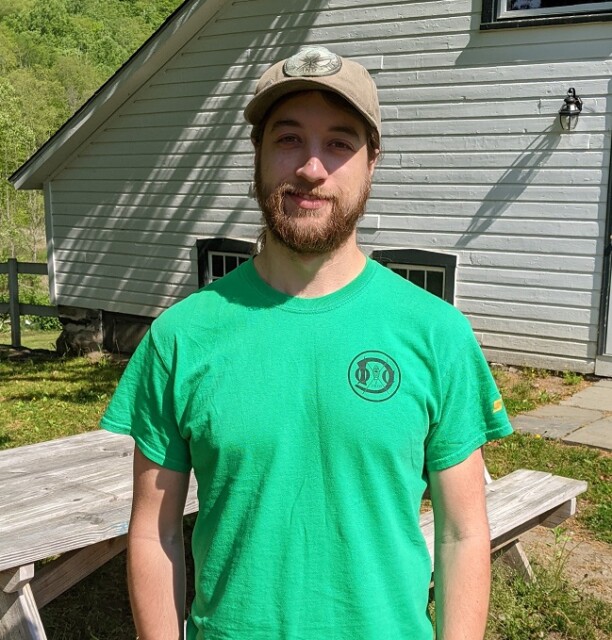
Wales Carter, Ph.D. (2021-2023)
Dr. Carter is a physiological ecologist who led two studies on the nutritional ecology of migratory songbirds during his fellowship at Great Hollow. One study examined the effects of invasive Japanese barberry on the diet composition of breeding songbirds while the other investigated the effects of diet-switching from invertebrates to fruit on the physiological condition of migrating songbirds during autumn. He also contributed to Great Hollow’s research on the quality of invasive plants as a food resource for birds and the effects of Japanese barberry removal on plants, insects, and birds. Prior to joining Great Hollow, Dr. Carter completed his PhD and a post-doctoral fellowship at the University of Rhode Island, respectively studying the effects of dietary fatty acids and antioxidants on the energy metabolism of songbirds, and the diet and spatial behavior translocated New England cottontails. He is currently doing additional post-doctoral research on New England cottontails at the University of Rhode Island.