
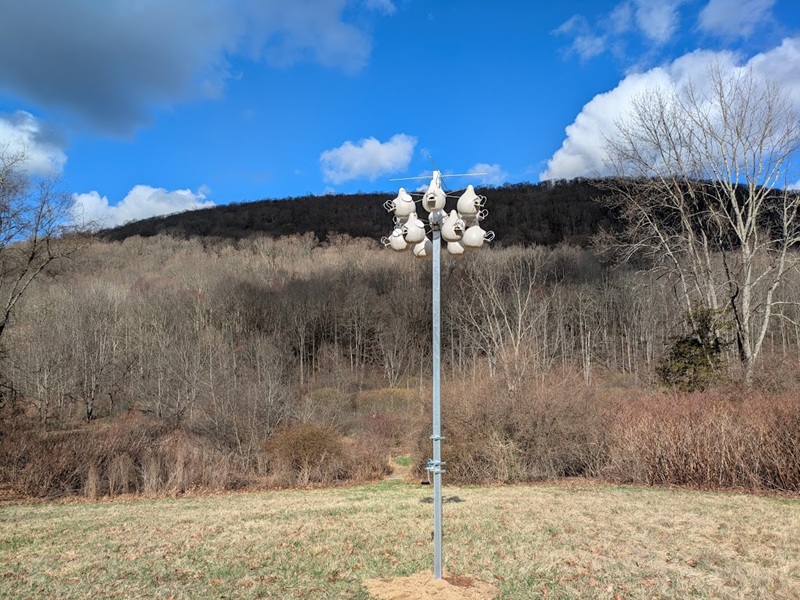
A New Home for Purple Martins
Great Hollow has continued its bird conservation work with the recent installation of a purple martin tower at its preserve, providing new nesting habitat for one of Connecticut’s most charismatic and conservation-dependent songbirds. Funded by a grant from the Connecticut Ornithological Association, the tower is intended to facilitate the growth and expansion a small population of purple martins that currently nests at the nearby Deer Pond Farm sanctuary and a private estate in Sherman. Great Hollow’s large emergent wetland and adjacent fields represent ideal foraging habitat for these birds, so by adding suitable nesting sites, we hope to attract a new colony to take up residence at our preserve.
Purple martins, the largest species of swallow in North America, have declined across much of the Northeast and are now a species of conservation concern in Connecticut. In eastern North America, they rely almost entirely on artificial nesting structures, such as the type of tower we recently installed. Their decline has been driven by habitat loss, competition from invasive cavity-nesting birds such as house sparrows and European starlings, and broader pressures affecting aerial insectivores, including climate change and declining insect abundance. Because purple martins are now so reliant on human-provided nesting sites, conservation actions like this tower installation can give a significant boost to local populations. New nesting structures not only increase habitat availability, but also create opportunities for long-term monitoring and public engagement, which we intend to take full advantage of.
 Previous Post
 Next Post