
New Paper Highlights High-Elevation Habitat for Wood Turtles
Great Hollow is pleased to announce the publication of our research on the habitat associations of wood turtles in New York’s Catskill Mountains, and the importance of high-elevation areas for conserving this species in a rapidly changing climate. The findings were published in the September 2026 issue of the Journal of Herpetology.
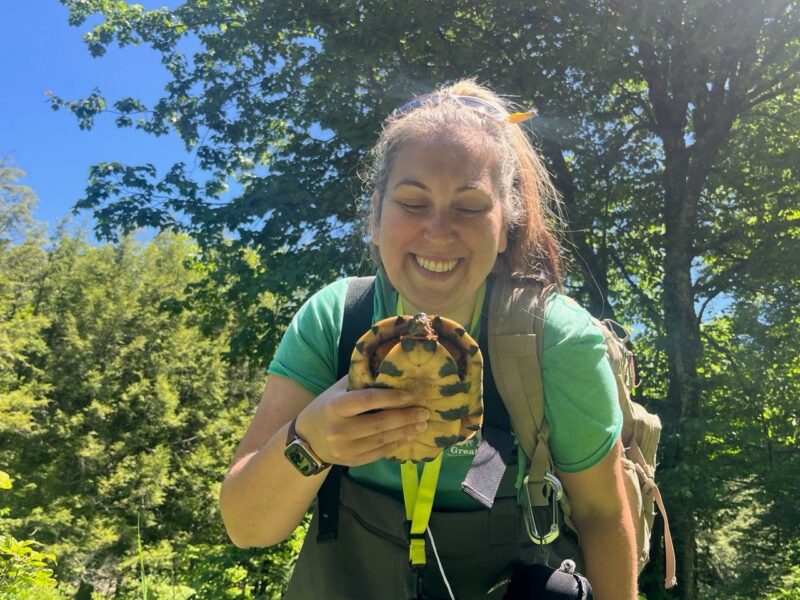
The project began in 2024 through a partnership with the New York State Department of Environmental Conservation and the Cary Institute of Ecosystem Studies, supported by the Catskill Science Collaborative. The study was led by Great Hollow’s Education Director Tara Ewers (pictured above) as a Catskill Science Fellowship and supervised by Executive Director Chad Seewagen, with important contributions from post-doctoral researchers Sarah Deckel and Griffin Nicholson and former Great Hollow naturalist John Foley.
The team surveyed streams throughout the Catskills to document where wood turtles occur and identify the habitat characteristics associated with their presence. They found that wood turtles were most likely to occur in mountain streams that had a relatively shallow gradient, curvy channels, slow-moving water, and fine substrates, and were bordered by shallow slopes, dense ground vegetation, and moderately open forest canopies. While the habitat associations of wood turtles in lowlands have been well-studied for decades, our study is the first to explicitly investigate their habitat associations near their elevational range-limit.
By documenting the habitat features that can support wood turtles in mountainous areas, the study’s findings will help natural resources agencies and conservation practitioners better predict the presence or absence of wood turtles in mountain streams that lack survey data, and identify high-quality habitats to prioritize for conservation and management. The study also calls attention to the increasing importance of mountains in our rapidly changing climate, which is causing animals to shift higher in elevation to find cooler temperatures. High-elevation populations of wood turtles have been largely overlooked in conservation planning for this species because of its traditional association with lowlands, but populations in mountainous areas may be the most likely to persist into the future as climate change renders low-elevation areas no longer suitable for wood turtles.
This is Great Hollow’s 21st contribution to the scientific literature, and the full article can be accessed here.
 Previous Post